The Evening Wind-Down Ritual: A Sound and Breath Guide for Deep Sleep
A step-by-step evening wind-down ritual using sound and breathwork to prepare your nervous system for deep, restorative sleep — backed by sleep science.
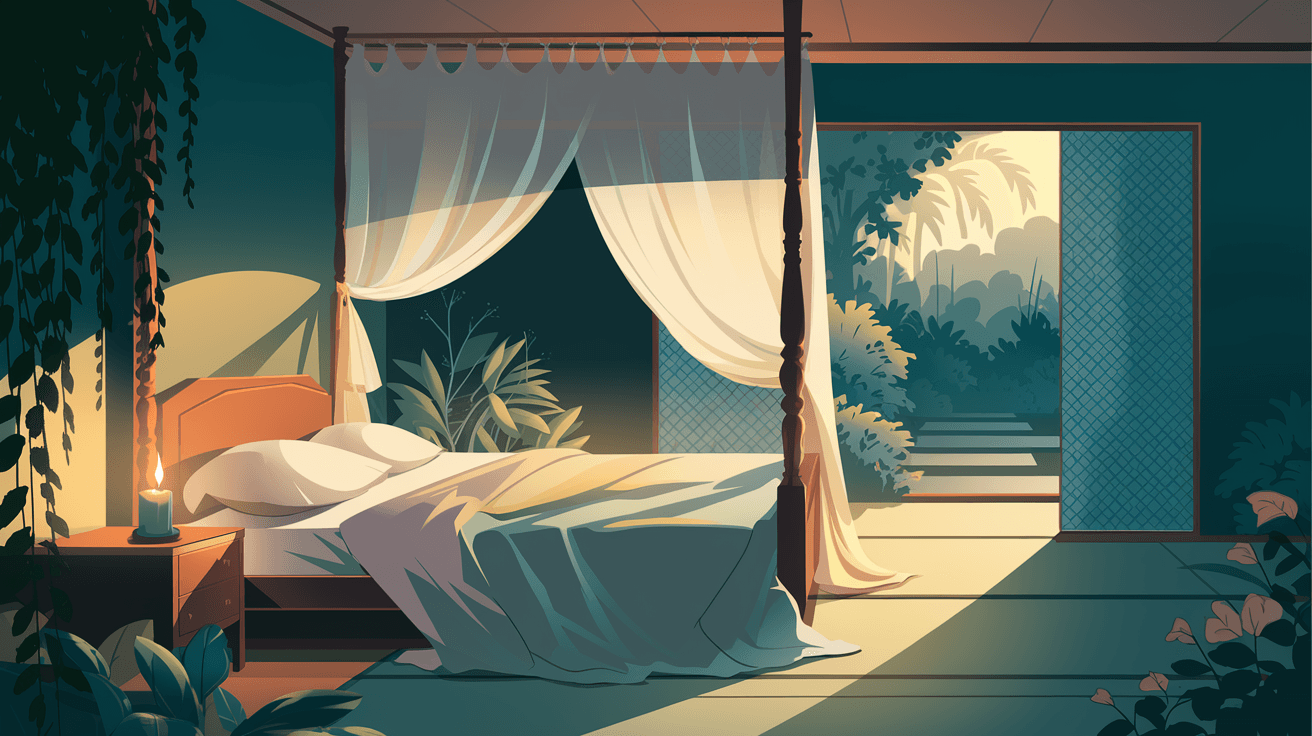
Quick Answer: An effective evening wind-down ritual combines dimmed light, a slow sleep soundscape, and simple breathwork — starting 60 to 90 minutes before bed. The sequence works by activating the parasympathetic nervous system, allowing melatonin to rise naturally and body tension to release before you ever close your eyes.
There is a particular quality to the last hour of a good day. A softness that arrives not from doing nothing, but from doing the right things — slowly, without urgency.
Most sleep problems are not problems of the night. They are problems of the hour before. We arrive at our beds still carrying the weight of the day: unread emails, unresolved conversations, screens still glowing in our peripheral vision. We expect sleep to do the heavy lifting of a transition we never made.
What if sleep was something you prepared for, the way you prepare a room for a guest?
This guide is that preparation. A step-by-step evening wind-down ritual built on sleep science and the calming power of sound — one that takes less than 90 minutes and costs nothing to begin tonight.
What a Wind-Down Ritual Actually Does to Your Brain
A wind-down ritual is a structured sequence of calming behaviors practiced in the 60 to 90 minutes before sleep to shift the nervous system from sympathetic arousal to parasympathetic rest.
This shift is not metaphorical. It is measurable. Research published in Sleep Medicine Reviews found that pre-sleep arousal — cognitive and physical — is one of the strongest predictors of sleep onset latency and nighttime waking. The body cannot enter deep sleep while still on alert.
Sound plays a specific role in this transition. A 2021 meta-analysis in Complementary Therapies in Medicine reviewed 13 studies on music and sleep quality and found that slow-tempo, low-complexity sounds (below 80 BPM) reliably reduced sleep onset time and improved sleep quality scores across age groups. The mechanism is largely cardiac: slow rhythmic sound entrains heart rate variability toward lower, more relaxed patterns.
Meanwhile, breathwork operates through the vagus nerve. The exhalation phase of breathing directly stimulates the parasympathetic response. Lengthening your exhale — as in the 4-7-8 technique — is one of the fastest physiological levers you have for moving out of a stressed state. A 2019 study by Zaccaro et al. in Frontiers in Human Neuroscience confirmed that slow breathing techniques (under 10 breaths per minute) significantly reduced anxiety scores and cortisol-linked arousal markers.
Together — sound and breath — they form a system. Each reinforces the other.
The 7-Step Evening Wind-Down Ritual
Step 1: Set a Fixed Wind-Down Start Time
Choose a consistent start time 60 to 90 minutes before your target sleep time and treat it as a daily anchor — as important as a wake-up alarm.
Consistency is the mechanism. Your circadian rhythm responds to pattern. When you begin dimming lights, lowering sound levels, and slowing your breathing at the same time each night, your brain begins anticipating sleep before you've done a single intentional step. Melatonin starts rising. Core body temperature begins to fall. The system primes itself.
As you build your sleep routine that actually works, the wind-down start time is the keystone habit — everything else depends on it.
Step 2: Dim the Lights and Silence Notifications
Before sound, before breath — address the light.
Bright overhead lighting, particularly light in the blue-white spectrum (5000–6500K), suppresses melatonin production by signaling to the suprachiasmatic nucleus that it is still midday. The American Academy of Sleep Medicine recommends avoiding bright light exposure for at least one hour before bed.
Switch to warm, dim lamps. Lower your phone brightness to minimum or use Night Shift mode. Set notifications to Do Not Disturb. This is not comfort advice. It is biology.
Once the room is right, the soundscape can do its work.
Step 3: Choose a Sleep-Friendly Soundscape
Open your sleep app and select a slow, steady soundscape. Pink noise, gentle rain, soft ocean waves, or low-frequency ambient pads all work well for most people. The criteria are simple: predictable, low-complexity, without sudden dynamic changes.
This matters because the brain continues processing sound even as it transitions toward sleep. Jarring or melodically complex audio — even music you love — can activate attention networks at precisely the moment you need them to quiet. Pink noise for sleep is particularly well-studied: it has been shown to enhance slow-wave sleep activity, the deep restorative phase most people don't get enough of.
Set the volume to a gentle background level — audible but not commanding. The sound should feel like weather, not performance.
Step 4: Practice 4-7-8 Breathing for Five Minutes
Sit or lie comfortably. Let the soundscape play softly behind you. Now breathe:
- Inhale through your nose: 4 counts
- Hold gently: 7 counts
- Exhale slowly through your mouth: 8 counts
Repeat for five minutes — roughly 4 to 5 full cycles per minute.
The long exhale is the active ingredient. Each extended out-breath stimulates the vagus nerve, slows heart rate, and signals safety to your nervous system. Over five minutes, the cumulative effect is measurable: blood pressure drops, muscle tension decreases, and mental chatter begins to loosen its grip.
Let the sound anchor your breath. Exhale into the rain, or the waves, or the hum of the night. Let each exhale feel like releasing something you no longer need to hold.
Step 5: Do a Sound-Anchored Body Scan
After breathwork, move your awareness slowly through your body — feet, calves, knees, hips, belly, chest, hands, arms, shoulders, neck, jaw, face.
At each area, notice without judgment. Then, on an exhale, allow that part of the body to soften into the sound in the background. You are not forcing relaxation. You are simply giving each part of yourself permission to rest.
This technique combines progressive muscle relaxation (PMR) with auditory anchoring. Research by Jacobson (1938) and subsequent replications show that systematically releasing muscle groups before sleep significantly reduces both subjective anxiety and time to sleep onset. Adding sound gives the mind a steady place to return when it wanders — and it will wander.
If you have found that anxiety disrupts your sleep, the body scan is especially valuable. Anxiety often lives in the body as physical tension long before it becomes conscious thought. The scan finds and releases it before it escalates.
Step 6: Transition to Passive Listening
When the body scan is complete, let go of all structure.
Stop guiding your breath. Stop directing your attention. Simply lie back and listen. The soundscape is still playing. Let it carry your awareness wherever it goes.
This is the transition from active practice to receptive rest. The brain moves from beta waves (alert, active) through alpha (relaxed, eyes closed) toward theta (drowsy, pre-sleep imagery). The soundscape provides a consistent anchor so the mind does not need to generate its own content to fill the quiet.
Thoughts may still arise. Notice them the way you would notice a distant sound — with mild curiosity, then returning to the nearer sound of rain or waves. You do not need to stop thinking. You only need to stop following.
Step 7: Use a Sleep Timer and Let Go
Set a sleep timer for 60 to 90 minutes so the sound fades naturally as you move into deeper sleep stages. This way, you do not need to wake to turn it off.
The ritual is now complete. Everything that could be done, has been done. Your body temperature is falling. Your melatonin is rising. Your nervous system is at rest.
Close your eyes. Let go of any remaining expectation about when sleep will arrive. Sleep is not something you do — it is something your body does when you stop getting in its way.
Practical Tips for Building the Habit
- Start with just 20 minutes if 90 minutes feels impossible. Even a shortened ritual is more effective than none.
- Same room, same routine matters. Environmental cues reinforce the ritual faster than any single technique.
- Keep the ritual screen-free from Step 2 onward. Use a Bluetooth speaker and a dedicated sleep app rather than streaming video in bed.
- Be patient with restless nights. The ritual builds cumulative benefit over days. One difficult night does not erase the practice.
For an even deeper foundation, explore the science of delta waves and deep sleep — understanding what happens in deep sleep stages makes the purpose of each ritual step more intuitive.
FAQ
How long before bed should I start my wind-down ritual? Most sleep researchers recommend beginning 60 to 90 minutes before your target sleep time. This gives your nervous system enough time to shift from sympathetic activation to parasympathetic rest, allowing melatonin to rise naturally.
Can I use my phone to play sleep sounds during the wind-down ritual? Yes, but switch to the lowest brightness or use a Bluetooth speaker. The goal is to use sound without blue light exposure. Many people keep their phone face-down or use a sleep sound app in audio-only mode.
What is the best breathing technique for falling asleep? The 4-7-8 technique is widely recommended for sleep because the extended exhale activates the parasympathetic nervous system. Box breathing (4-4-4-4) is a gentler alternative if holding breath feels uncomfortable.
Does the type of sound matter for a sleep ritual? Yes. Sounds with slow, predictable frequencies — like pink noise, rain, or gentle ocean waves — are most effective for sleep onset. Avoid binaural beats designed for focus, upbeat music, or sounds with sudden dynamic shifts.
What if my mind keeps racing even during the ritual? This is normal. Rather than fighting thoughts, try briefly acknowledging them ('I'm thinking about tomorrow') and returning your focus to the sound. Keeping a small notepad nearby to write down persistent thoughts before starting the ritual can help clear working memory.
Begin Tonight
The ritual asks very little of you. A dimmed lamp. A soundscape. Five minutes of slow breathing. A quiet survey of your own body. Then — nothing more.
The Sleep Universe in Yuzen includes soundscapes designed specifically for this kind of gradual descent: Dream Rain, Night Ocean, and others built from frequencies that ease rather than engage. Let the sound lead you somewhere your mind has been needing to go.
Sleep is not a destination you reach. It is a direction you begin moving in — gently, one exhale at a time.
Research References
- Zaccaro, A. et al. (2019). How Breath-Control Can Change Your Life: A Systematic Review on Psycho-Physiological Correlates of Slow Breathing. Frontiers in Human Neuroscience, 12, 353.
- de Niet, G. et al. (2009). Music-assisted relaxation to improve sleep quality. Journal of Advanced Nursing, 65(7), 1356–1364.
- Ong, J. C. et al. (2017). A randomized controlled trial of mindfulness meditation for chronic insomnia. Sleep, 37(9), 1553–1563.
- Harvey, A. G. (2002). A cognitive model of insomnia. Behaviour Research and Therapy, 40(8), 869–893.
- Zhou, J. et al. (2012). Pink noise: Effect on complexity synchronization of brain activity and sleep consolidation. Journal of Theoretical Biology, 306, 68–72.
- Jacobson, E. (1938). Progressive Relaxation. University of Chicago Press.
Explore More in Yuzen